Table of Contents
- Understanding Needle Failures
- 1. Pulling and Forcing Fabric Through the Feed Dogs
- 2. Choosing the Wrong Needle Size for Fabric Density
- 3. Improper Needle Installation Configurations
- 4. Unbalanced Thread and Bobbin Tension Discs
- 5. Severe Shuttle Hook and Needle Bar Timing Issues
- Preventative Maintenance for Flawless Stitching
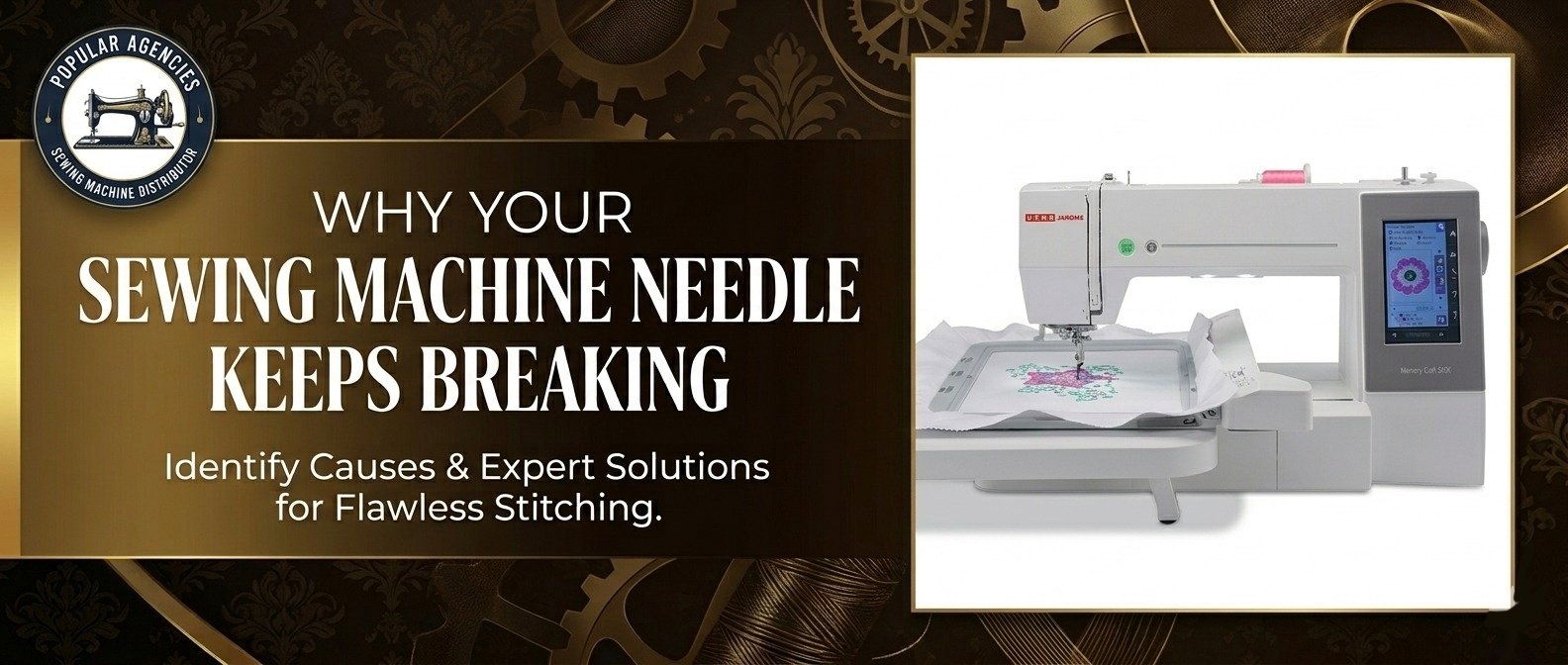
Sewing machine needle breaking issues can bring any creative textile design session or urgent commercial apparel order to an immediate, frustrating halt. Beyond the disruption to your workflow, a snapping needle poses a genuine safety hazard to your eyes and can leave deep, permanent scratches across your equipment’s polished throat plate or internal hook assembly.
If you discover that your needles are bending, striking the metal work plates, or shattering into pieces repeatedly, it is not simply bad luck. Instead, it is a clear mechanical symptom that something inside your tension, feeding, or alignment system is severely out of sync.
As a premier authorized distributor of industrial and household machinery, we encounter this specific problem daily. Let us break down the exact mechanical causes behind a persistent sewing machine needle breaking error and explain how you can implement immediate, long-term fixes right from your workshop bench.
[Image Idea: Close-up of a needle bar clamp assembly being adjusted with a small screwdriver]
1. Pulling and Forcing Fabric Through the Feed Dogs
The single most common operational mistake that results in a continuous sewing machine needle breaking loop is manually pulling, dragging, or pushing the textile fabric while the machine is actively cycling through stitches.
When executing complex seams on thick fabrics like heavy canvas, denim waistbands, or multi-layered drapes, it is natural to want to assist the machine by tugging the material from behind the presser foot. However, doing this creates lateral force on the needle blade.
As the needle bar travels downward at high speed, this continuous manual pulling bends the needle blade slightly out of its vertical path. This causes the sharp tip to strike the solid steel needle plate instead of dropping cleanly through the center slot, resulting in an immediate break.
The Professional Fix: You must allow the machine’s internal feed dogs to handle 100% of the movement work. Your hands should remain relaxed, lightly guiding the outer edges of the fabric to direct the straightness of the seam without applying forward or backward force.
2. Choosing the Wrong Needle Size for Fabric Density
Another major reason behind a frequent sewing machine needle breaking emergency is mismatching the structural size of your needle with the actual weight and density of the target textile.
Attempting to pierce heavy upholstery leather, industrial webbing, or multiple folds of winter wool using a fine, lightweight domestic needle will cause the slim steel shank to deflect and snap instantly upon impact. Conversely, using a heavy needle on delicate silks can ruin the garment weave.
To avoid bending, shattering, or deflection, you must consistently match your needle size specification with the job requirement. Refer to this definitive industry size breakdown to ensure structural compatibility:
- Size 11 (75): Optimized for lightweight sheer fabrics, fine silk, organza, and satin weaves.
- Size 14 (90): The standard baseline configuration for everyday cotton apparel, linen, and medium synthetics.
- Size 16 (100): Engineered for dense denim work, canvas bags, lightweight curtains, and thick corduroy.
- Size 18 (110): Designed for heavy-duty commercial tailoring, leather goods, and thick multi-layered upholstery.
For more technical details on choosing accessories, check out the official global specifications provided directly on the Usha Sew Official Portal to ensure you are selecting compatible components for your exact model setup.
[Image Idea: Infographic displaying different sewing machine needle sizes side by side]
3. Improper Needle Installation Configurations
If you recently performed maintenance or swapped out your tooling and immediately experienced a sewing machine needle breaking sound, the root cause is likely an incorrect physical insertion layout.
When a needle is clamped into position loosely or sits off-angle, it cannot clear the tight tolerances of the oscillating hook underneath. If the needle shank is not shoved entirely upward into the socket clamp before you tighten the lock screw, the entire assembly sits too low.
This structural drop means the needle tip will collide heavily with the metal walls of your rotating bobbin basket during its downward stroke. This collision instantly breaks the needle and can easily knock your machine’s entire internal gear timing configuration out of balance.
The Professional Fix: Loosen the needle clamp screw fully. Ensure the flat side of the needle shank faces the correct direction specified by your manufacturer manual. Push the needle straight up into the housing block until you feel it physically hit the top stopper pin, then lock the screw tightly with a flathead driver.
4. Unbalanced Thread and Bobbin Tension Discs
Severe tension imbalances can bend your needle bar line and cause an unexpected sewing machine needle breaking event right in the middle of a high-speed stitch sequence.
When your upper thread tension dial is dialed up to an extreme number, or if the thread gets physically trapped or knotted around the spool pin, the thread path tightens dramatically. As the machine pulls the thread back up to lock the stitch, this intense tension exerts a powerful lateral pull against the eye of the needle.
This continuous pulling forces the needle tip to bend backward out of alignment. Over several hundred stitches per minute, this flex causes structural fatigue until the metal needle fails and shatters inside the throat plate cavity.
The Professional Fix: Reset your upper tension discs to a standard neutral baseline value (typically between 3 and 5 for modern automatic zig-zag machines like the Singer FM 8280). Always check that your thread path is completely free of snags, lint buildup, or improper threading loops before starting a project.
5. Severe Shuttle Hook and Needle Bar Timing Issues
When you have cleared out lint, verified your fabric weight, installed a fresh needle correctly, and still suffer from instant sewing machine needle breaking, you are dealing with an internal timing misalignment.
Your machine operates on a highly precise mechanical timeline: the needle bar must descend, and as it begins to rise, the tip of the rotary shuttle hook must pass exactly behind the needle’s scarf to catch the upper thread loop cleanly. If your machine experiences a bad jam, the internal gears can slip out of sync.
When your timing is out of alignment, the shuttle hook and the needle bar travel down the path simultaneously, causing them to physically crash into one another beneath the needle plate. This metal-on-metal collision will break any needle instantly, regardless of its size or thickness.
The Professional Fix: Internal timing repairs require specialized mechanical gauges and technical alignment expertise. To safely resolve these deep mechanical synchronization errors, you should consult an authorized repair station.
For additional step-by-step diagnostic procedures regarding commercial hardware maintenance, you can reference the comprehensive troubleshooting walkthroughs hosted on the Singer Machines Resource Center for deep-dive technical support.
Preventative Maintenance for Flawless Stitching
To avoid a sudden sewing machine needle breaking incident in the future, try to adopt a consistent, proactive care routine for your equipment. Always clean out packed fabric lint from beneath your needle plate after every 8 to 10 hours of active stitching, use premium, clear machine lubricants on your hook race joints, and replace your needle entirely after every large garment project.
Need a Comprehensive Equipment Tune-Up? If your machine continues to jam, click loudly, or snap needles despite trying these steps, it likely requires professional mechanical calibration. Bring your equipment head straight to the Popular Agencies Authorized Service Center. Our factory-trained specialists will safely open up your machine housing, align your timing synchronization, and restore your system to smooth, quiet operation!


Add comment