
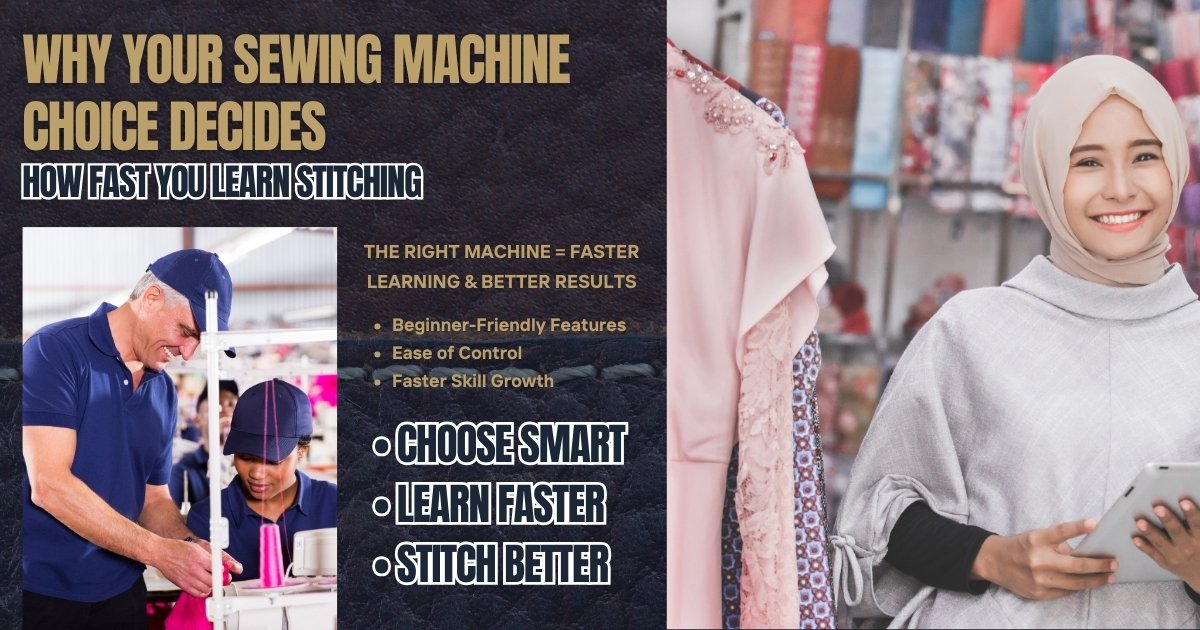
Why Your Sewing Machine Choice Decides How Fast You Learn Stitching
When people struggle to learn stitching, they often blame themselves.
“I’m not good with my hands.”
“Maybe sewing isn’t for me.”
“I’m learning too slowly.”
But in many cases, the real problem isn’t the person.
It’s the sewing machine.
Your sewing machine plays a much bigger role in your learning speed than most people realise. The right machine builds confidence, clarity, and momentum. The wrong one creates friction, confusion, and self-doubt.
This blog explains how your sewing machine choice directly affects how fast (or slow) you learn stitching, and what actually helps beginners progress smoothly.
Learning Sewing Is About Feedback, Not Just Practice
When you’re learning stitching, every action gives feedback:
- How the fabric moves
- How the stitch forms
- How mistakes appear
A good sewing machine gives clear, predictable feedback.
A poor or mismatched machine gives confusing signals.
If you don’t understand why something went wrong, learning slows down dramatically.
The Biggest Learning Blocker: Fighting Your Own Machine
Many beginners unknowingly start with machines that:
- Skip stitches
- Break thread frequently
- Pull fabric unevenly
- Vibrate excessively
- Require constant re-adjustment
Instead of focusing on:
- Hand control
- Fabric guidance
- Stitch consistency
They end up fighting:
- Tension issues
- Needle problems
- Mechanical distractions
This doesn’t teach stitching — it teaches frustration.
How the Right Sewing Machine Accelerates Learning
Let’s break this down practically.
1. Smooth Operation Builds Muscle Memory Faster
Learning stitching is about repetition.
When the machine runs smoothly:
- Your hands relax
- Movements become natural
- Coordination improves faster
A jerky or noisy machine breaks rhythm, slowing muscle memory development.
2. Consistent Stitching Teaches Cause & Effect
Beginners learn by observing:
- “When I guide fabric like this, the stitch looks better.”
- “When I pull fabric, stitches distort.”
A machine that produces consistent stitches makes learning logical.
Inconsistent machines blur cause and effect, making progress slower.
3. Simple Controls Reduce Cognitive Load
When you’re learning, your brain is already busy:
- Watching the needle
- Controlling fabric
- Managing speed
A machine with clear, simple controls allows your brain to focus on technique — not settings.
Too many features too early overwhelm beginners.
Why Beginners Often Learn Faster on the “Right Simple Machine”
Many people assume:
“More features = faster learning.”
In reality:
- Too many stitch options confuse beginners
- Automation hides basic understanding
- Errors feel harder to diagnose
A well-built, beginner-friendly machine often teaches faster than a complex one.
Not because it does more — but because it does less, clearly.
The Fabric–Machine Relationship Matters More Than You Think
Your learning speed also depends on how well your machine handles fabric.
If your machine struggles with:
- Thickness
- Layers
- Stretch materials
You’ll assume you’re doing something wrong.
In truth, the machine may simply be unsuited for that fabric.
A machine that matches your fabric type:
- Builds confidence
- Reduces mistakes
- Speeds up understanding
Common Learning Delays Caused by the Wrong Machine
Here are real scenarios that slow learning:
Machine too weak for fabric
→ Beginner thinks they lack skill
Machine vibrates excessively
→ Hard to control speed
Thread breaks often
→ Learner loses rhythm
Poor stitch visibility
→ Hard to understand mistakes
Each issue compounds, making learning feel harder than it is.
The Psychological Side of Learning Sewing
This part is rarely discussed.
When beginners face constant problems:
- Motivation drops
- Practice reduces
- Self-belief weakens
When the machine behaves well:
- Progress feels visible
- Confidence grows
- Practice becomes enjoyable
Learning speed isn’t just mechanical — it’s emotional.
Should Beginners Start with Automatic Sewing Machines?
This depends on the person.
Automatic machines can:
- Reduce frustration
- Improve early results
- Boost confidence
But they can also:
- Hide fundamentals
- Slow deep understanding
- Create dependence on automation
The fastest learners usually start with:
- A stable, easy-to-control machine
- Enough features to help
- Not so many that learning becomes passive
How to Choose a Sewing Machine That Helps You Learn Faster
Instead of asking:
“Which sewing machine is best?”
Ask:
- Is it stable and smooth?
- Does it stitch consistently?
- Is it comfortable to control?
- Does it suit my fabric type?
- Will it support me for at least 1–2 years?
Learning speed improves when the machine supports learning, not distracts from it.
When Upgrading Can Suddenly Boost Learning
Many people experience this moment:
“I didn’t realise sewing could feel this easy.”
This often happens after upgrading from:
- A poorly matched machine
- An unstable beginner model
- An underpowered setup
Suddenly:
- Stitching improves
- Mistakes reduce
- Confidence jumps
Not because skills changed overnight — but because resistance was removed.
Final Thoughts: Your Machine Is Your First Teacher
Before any pattern, tutorial, or class, your sewing machine teaches you:
- Control
- Rhythm
- Feedback
- Confidence
If that teacher is confusing, learning slows.
If that teacher is supportive, learning accelerates naturally.
So if you feel stuck, don’t immediately blame your hands or patience.
Sometimes, the fastest way to learn stitching…
is simply choosing the right machine.




Add comment